
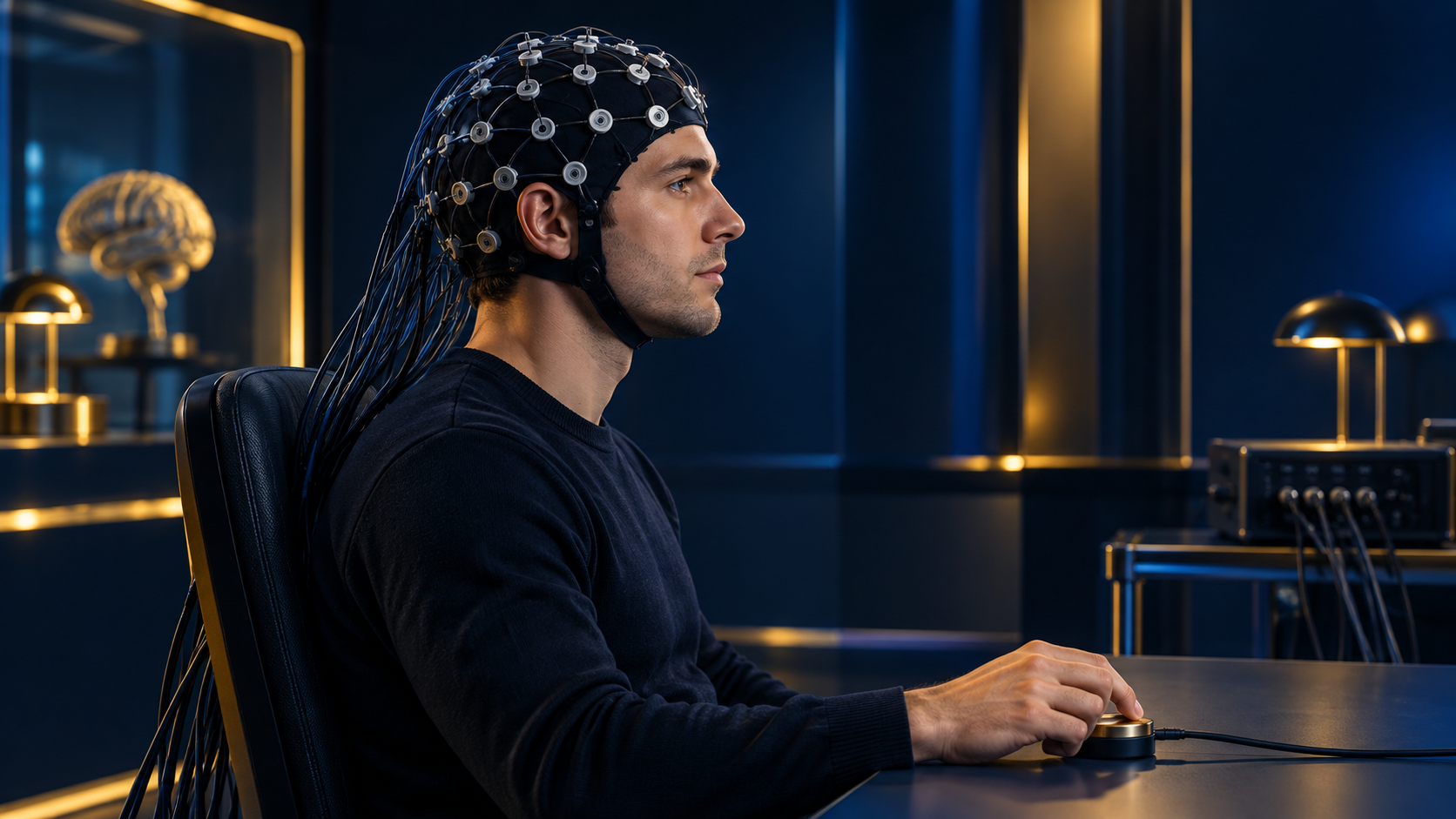
Brain potentials are time-locked observations
Electroencephalography can record electrical activity at the scalp with high temporal resolution. Certain event-related potentials, including the error-related negativity or ERN, have been investigated in tasks where participants make rapid responses and sometimes commit identifiable errors. Holroyd and Coles proposed a computational account linking reinforcement learning and error processing, with attention to the anterior cingulate system [1]. The work is influential, but the existence of an ERN in a laboratory task does not establish that a trading desk can read regret, detect a hidden intention or predict whether the next gold trade will succeed. The events, tasks and signal-processing procedures matter.
To compare an EEG signal with a trading-rule breach, the researcher first needs an objective definition of breach. A person may close a position quickly because the strategy's invalidation condition was met; another may close at an unplanned price because of anxiety; a third may click the wrong control. The raw behavior may look similar in a log, but it is not necessarily the same error class. ERN studies often benefit from repeated, tightly timed responses. Live trading decisions can unfold over minutes and incorporate continuous revision. The experimental challenge is therefore one of construct and temporal alignment, not merely putting electrodes on a trader.
Autonomic and neural responses do not always match
Hajcak, McDonald and Simons examined error-related brain potentials together with skin conductance, heart rate and subsequent behavior [2]. Their reported relationships differed across the ERN and later error positivity components, illustrating that even two closely related brain signals may not map onto autonomic responses in the same way. It would be scientifically misleading to compress these responses into a single number called 'self-control'. The meaning of an apparent neural change must be evaluated against task difficulty, baseline performance, signal artifacts and statistical reliability. A post-error potential is not a clinical diagnosis or evidence of a moral failure.
Trading introduces further problems absent from simplified response tasks. Price changes are externally generated, but the trader chooses when to observe or act. There may be no precise event onset for the subjective realization that a choice was wrong. The same order may be evaluated differently after information becomes available, producing hindsight bias. A research protocol that labels errors by whether the trade eventually lost money would confound decision process with market randomness. Researchers should instead use predefined rules and decision-time information to classify whether the process was followed.
From compelling signals to credible predictive models
Scheinost and colleagues provided practical guidance for predictive modeling of individual differences in neuroimaging, emphasizing independent validation [3]. Their methods are not an endorsement of any proposed NSI trading device. The relevance is procedural: signal selection, feature construction and parameter tuning should be separated from the observations used for final evaluation. EEG datasets can be high-dimensional relative to the number of participants; flexible modeling can fit artifacts or participant identity instead of a decision construct. Blocked cross-validation and participant-level holdouts are necessary where sessions are correlated. Confidence intervals should accompany every performance claim.
Signal processing itself introduces a large space of researcher decisions. Choices about filtering, artifact rejection, reference electrodes, epoch length and baseline correction can change the appearance of an event-related potential. If the same dataset is repeatedly adjusted until a desired trading-performance association appears, the final apparent effect will be overstated. Preprocessing should follow a documented plan, with sensitivity analyses that show whether results survive reasonable alternative choices. Researchers should also control for movement and eye artifacts that may be more common during emotionally salient chart events. The event labels must be determined independently of the EEG pattern to avoid circular validation. Transparency about rejected trials and unusable recordings is as important as displaying an attractive group-average waveform.
A cautious pilot study might use a standardized simulated decision task with known rule violations, repeated trials and clearly defined EEG epochs. It would compare behavioral records alone against behavior plus EEG, then evaluate transfer to a second sample. If EEG adds no incremental value, that negative result is important. Why Profitable Trades Can Still Be Bad Decisions supplies the conceptual distinction between process and outcome, while The Five Dimensions of the Nervous System Indicator clarifies that Cognitive Control is still a proposed NSI dimension, not a device-ready clinical score. A rigorous paper must say which proposition it actually tested. In conclusion, EEG offers a way to study neural dynamics during well-defined actions, but it does not eliminate the need to specify what an error is. The route from error-related potentials to dependable trading-decision research requires transparent labeling, reproducible preprocessing and external validation. NSI research should prefer a modest but testable claim over a spectacular dashboard that infers intention from a waveform. That preference is scientific strength, not diminished ambition.
Scientific bibliography & sources
- Holroyd and Coles (2002), neural basis of error processing https://pubmed.ncbi.nlm.nih.gov/12374324/
- Hajcak, McDonald and Simons (2003), autonomic responses and error monitoring https://pubmed.ncbi.nlm.nih.gov/14986842/
- Scheinost et al. (2019), predictive modeling of individual differences in neuroimaging https://pubmed.ncbi.nlm.nih.gov/30831310/
Research note
NSI is a proposed research framework, not an independently validated medical or financial prediction system. This article is research and education, not individualized medical or investment advice. Market observations are timestamped historical context, not live prices.
 Research
 Research
 Research