
The unresolved question behind a physiological signal
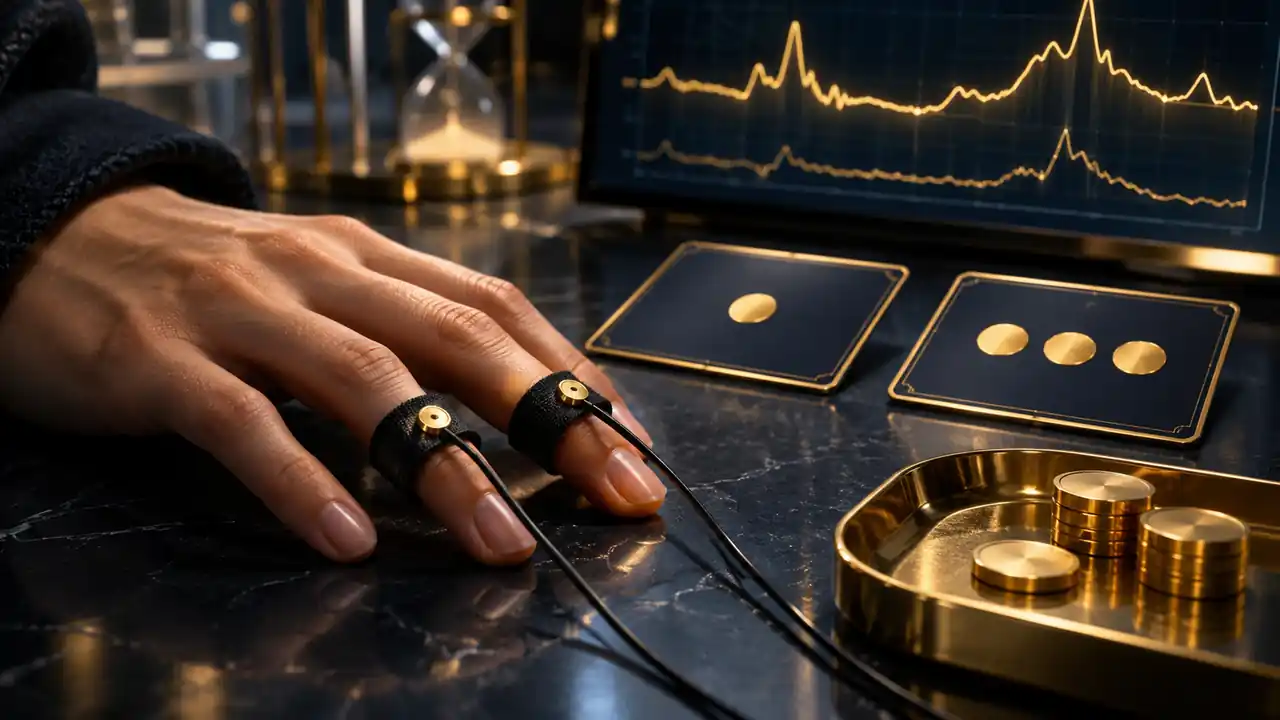
Skin conductance measures changes in electrical properties of the skin associated in part with sympathetic sudomotor activity. It is a physiological observation, not a direct label for fear, greed or a profitable decision. The important research question is whether anticipatory electrodermal responses supply information about a particular decision process after competing explanations, including conscious knowledge, have been considered. The answer requires an experimental task, accurate timing and careful interpretation. A wearable device that reports a changing signal cannot by itself explain why a person chose one financial action over another. Bechara, Damasio, Tranel and Damasio reported findings from a gambling task in which healthy participants and patients with prefrontal damage chose among decks with different reward-and-loss characteristics [1]. Their interpretation emphasized bodily signals that appeared to precede explicit knowledge of the advantageous strategy. This influential paper opened a research question; it did not establish a general-purpose physiological predictor of investment outcomes. The task was constructed with experimentally controlled deck contingencies. The uncertainty of a real gold market includes multiple agents, changing probabilities and strategic responses not built into those decks.
A common interpretive error is to replace an operational variable with an emotional story. An increased skin-conductance response can accompany arousal without identifying whether its cause is anxiety, anticipation, temperature, orienting or other influences. Even if an experimental difference between conditions is statistically detectable, that finding does not imply accurate classification of an individual trader's motive. The related NSI discussion [Heart-Rate Variability Requires a Protocol Before It Can Describe Stress](/publications/nsi-2026-10-30-research-02) demonstrates why physiological measurement validity must precede psychological labeling.
What anticipatory and outcome signals can mean
Crone and colleagues examined heart rate and skin conductance preceding and following choices in an analogue of the Iowa gambling task [2]. Their analysis distinguished anticipatory measures from physiological responses after outcomes, and observed different patterns across participant performance groups. This matters because a measurement made after an adverse outcome is not equivalent to one taken before a choice. Without event timestamps, a correlation may reflect reaction rather than anticipation. A proposed decision-state algorithm must therefore define which interval is used and ensure no post-decision information leaks into a purported prediction. The finding also reminds researchers to avoid averaging away meaningful heterogeneity. People with different task performance may not show identical physiological patterns. However, subgroup observations are vulnerable to small-sample uncertainty and cannot automatically justify assigning diagnostic labels. To test an NSI feature, investigators would need predeclared outcome definitions, a robust artifact-cleaning protocol, baseline normalization and a separate set of participants who were not used to select thresholds. Otherwise excellent-looking results could reflect tuning to the original sample.
The combination of physiological and behavioral data can still be informative. A laboratory researcher might ask whether a prechoice signal predicts an independently coded lapse after controlling for the subject's prior choices and knowledge of reward contingencies. That is a falsifiable question. It is different from claiming that a higher wrist-sensor value means the person is about to buy gold irrationally. The latter jumps across measurement domains without direct evidence.
The challenge from participants' conscious knowledge
Maia and McClelland reexamined the claim that advantageous gambling-task behavior emerges before conscious knowledge [3]. Using more sensitive questions about what participants knew, they found evidence of reportable knowledge sufficient to account for advantageous choices in the task. Their analysis challenged a strong interpretation of unconscious bodily guidance. It does not prove that emotions or physiological signals play no role in decision-making. Instead it illustrates a fundamental methodological requirement: before inferring an unconscious process, measure the supposedly absent conscious process with adequate sensitivity. This debate is valuable for neurofinance precisely because an appealing causal narrative can outrun the evidence. A physiological response and a choice may be associated for multiple reasons. The person may have learned reward probabilities, recognized a pattern consciously, reacted emotionally or responded to a task feature. If researchers measure only physiology and choices, they cannot discriminate among these accounts. A good experiment adds explicit knowledge probes and tests whether the physiological measure explains variance beyond them.
The NSI discussion [What Does NSI Measure? Construct Validity Before Composite Scores](/publications/nsi-2026-10-29-research-04) provides the broader framework: a proposed construct needs discriminant validity, not only a correlation with one familiar laboratory task. A skin-conductance variable must be shown to convey something distinct from general arousal or movement artifact before it can be given a specialized interpretation. Repeating the word 'fear' over a sensor trace does not perform that validation.
An appropriate research design and a limited conclusion
A rigorous protocol could synchronize electrodermal signals, heart rate, task events, self-reported knowledge and behavioral outcomes. It would prespecify artifact handling, response windows and baseline correction. Separate training and test participants would be essential if any classification model were fitted. The investigators should report sensitivity and specificity alongside confidence intervals, and compare the physiological model with simpler behavioral baselines. In a market extension, real-world decisions would additionally require verified timestamps, costs and nonstationary outcomes. Any such study would also need to explain ethical and practical limits. Physiological monitoring can be intrusive, and a false label may itself alter someone's behavior. A researcher should not present a speculative biomarker as clinical assessment, stress diagnosis or an instruction to trade. The already published NSI article [Heartbeat Perception and Trader Survival](/publications/nsi-2026-11-05-research-01) explores a different physiological construct and likewise does not establish predictive validation.
The conclusion is that physiological responses can be studied in controlled decision tasks [1–2], but their meaning depends on timing, task design and competing explanatory variables. The conscious-knowledge challenge [3] shows why simple stories about an unconscious signal can be premature. NSI is a proposed interdisciplinary framework; it is not a clinically validated state detector or a financially validated forecasting system. Skin conductance deserves careful measurement, not a marketing label that turns every fluctuation into a prediction.
Scientific bibliography & sources
- [1] Bechara A et al. Deciding advantageously before knowing the advantageous strategy. Science (1997). https://pubmed.ncbi.nlm.nih.gov/9036851/
- [2] Crone EA et al. Heart rate and skin conductance analysis of antecedents and consequences of decision making. Psychophysiology (2004). https://pubmed.ncbi.nlm.nih.gov/15189476/
- [3] Maia TV, McClelland JL. A reexamination of the evidence for the somatic marker hypothesis. PNAS (2004). https://pmc.ncbi.nlm.nih.gov/articles/PMC528759/
Research note
NSI is a proposed research framework, not an independently validated medical or financial prediction system. This article is research and education, not individualized medical or investment advice. Market observations are timestamped historical context, not live prices.
 Research
 Research
 Research