
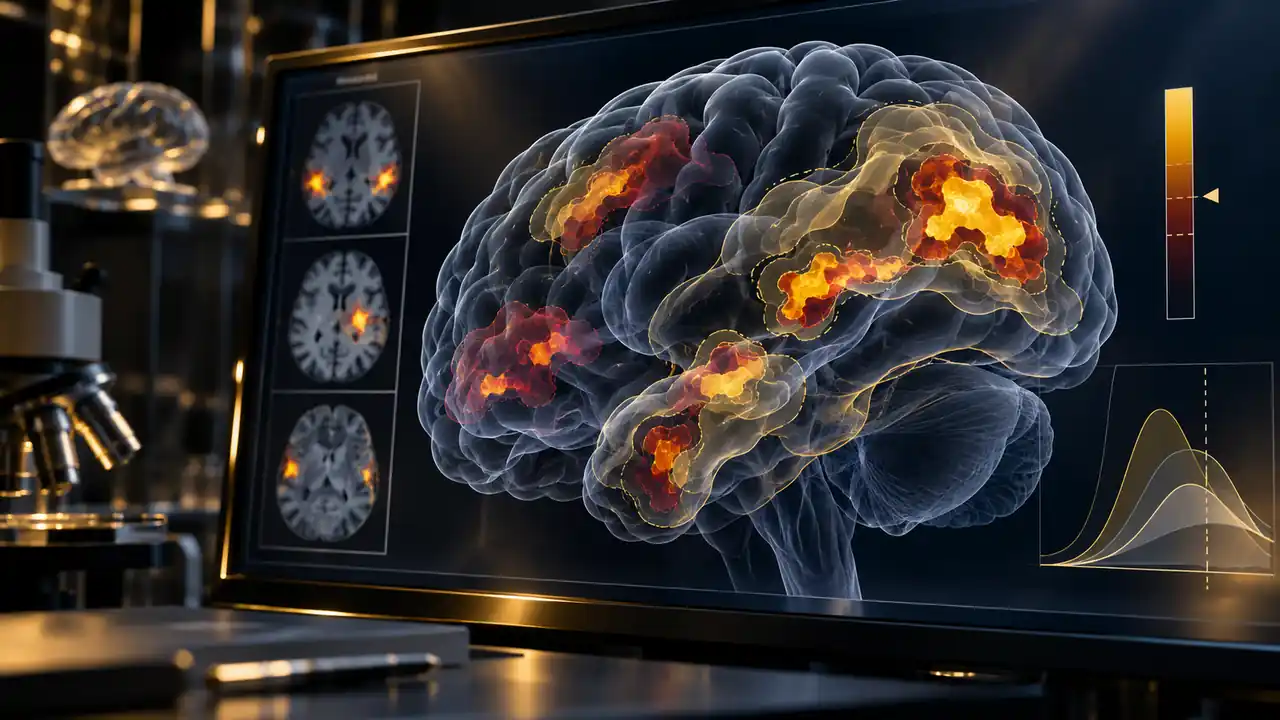
What does a colored cluster on a brain map actually establish?
A bright patch on a functional MRI image can look like direct evidence that a brain region encodes a particular psychological state. In reality, such a cluster is the result of many operations performed on noisy, indirect measurements of blood-oxygen-related changes. Statistical thresholds, assumptions about spatial dependence and multiple-comparison corrections influence which patches appear. The central question is whether a particular spatial pattern would still meet a defined error criterion when no true task effect is present. This issue matters for any proposed NSI model that might eventually use neuroimaging evidence to support claims about attention, arousal or decision-making.
Eklund, Nichols and Knutsson used real resting-state fMRI data and simulated task analyses to test how often different statistical approaches generated significant findings under null conditions [1]. Their widely discussed results identified problems with certain parametric clusterwise inference approaches. The appropriate takeaway is method-specific rather than apocalyptic: some procedures under some assumptions produced more false positives than the nominal error rate would suggest. The research did not show that every activation map is invented, that all studies using MRI are invalid or that the brain lacks measurable task responses. An image has persuasive visual authority because it appears anatomical, colored and precise. Yet inferential uncertainty is not encoded automatically in its appearance. A large cluster may reflect a thresholding procedure as much as a large underlying effect, and its location alone does not identify a mental state. Earlier NSI work on [Frontal Theta Is a Control-Related Signal, Not a Financial Forecast](/publications/nsi-2026-10-30-research-01) raises a parallel issue for EEG: even a reliably observed neural feature does not validate a particular economic prediction.
Why false positives and false discoveries are different error questions
Cluster inference frequently asks whether a spatially extended set of voxels is unlikely under a specified null model. Error control depends on assumptions about the data and the family of tests. A claim of a nominal five-percent familywise error rate is not a universal property of every thresholded image; it depends on the procedure actually satisfying its conditions. If assumptions fail, the advertised rate may not describe observed behavior. This is a statistical concern, not simply a technical argument about image-processing software. Subsequent methodological discussion by Kessler, Angstadt and Sripada examined nonparametric control of false discovery rates in relation to the cluster-inference debate [2]. Familywise error and false discovery rate are not identical definitions of error. The first concerns the probability of making at least one false rejection in a family of tests; the second concerns the expected share of false discoveries among discoveries, under an appropriate framework. A result evaluated with one criterion should not be promoted as though it satisfied the other. Readers need the exact statistical unit and procedure.
An additional response by Cox and colleagues revisited fMRI clustering and false-positive issues [3]. Its existence illustrates that scientific evaluation continues after a high-profile methodological result. Differences among implementations, null models and thresholding strategies deserve detailed inspection rather than a slogan that one famous paper permanently solved or destroyed brain imaging. This article does not adjudicate every technical dispute. It stresses that a conclusion about one software procedure must stay attached to the tested settings and error definition.
What a prospective neurofinance validation would need
Suppose researchers claim that a particular neural cluster represents fear before a risky decision. To evaluate the statement, one must first establish the experimental contrast and independent behavioral definition of fear. A region's activity may also vary with novelty, task difficulty, sensory properties or movement. If the construct is not well defined, more sophisticated statistical correction cannot repair the interpretive gap. Correct inference about a signal and correct labeling of a psychological state are separate validity problems. Next, the investigators would need to specify preprocessing, artifact treatment, spatial thresholds, participant exclusions and the correction for the relevant comparisons before inspecting the most favorable result. Null-data checks or permutation procedures, where assumptions allow, can help evaluate whether a claimed error rate is credible. The study must also report uncertainty and provide enough information for independent replication. The related NSI report [One Brain Dataset, Many Results](/publications/nsi-2026-11-05-research-03) examines analytic flexibility as another route to overstated confidence.
Finally, showing a statistical association in a laboratory does not establish diagnostic or predictive utility in the market. A robust brain correlate of an experimentally induced task condition might still have little discriminative value for an individual on a different day. Translating to finance would require prospective outcomes, suitable comparison models, avoidance of temporal leakage and accounting for real costs. No colorful brain map can stand in for those steps. The proposed NSI framework is not a clinically validated diagnostic instrument or a financially validated forecasting system.
An evidence standard for reading activation figures
Readers should ask five questions of a displayed activation cluster. What is the experimental contrast? How were the data preprocessed? Which statistical error quantity was controlled? Was the result confirmed in participants or sessions not used to choose the analysis? And what independent evidence connects the measured activity to the psychological label in the caption? Failure to answer one question does not automatically falsify the result, but it should lower confidence in an expansive interpretation. Investigators also need to distinguish the display threshold used to make a visually clear figure from the inferential threshold used to support the scientific claim. A publication may show a smoothed or color-scaled image for communication, but that visual choice should not quietly change the hypothesis test. Software versions and parameter settings should be recorded, and negative or ambiguous findings should not vanish because they are less visually impressive. These practices make work more auditable rather than guaranteeing that every finding is correct.
The conclusion is that error calibration belongs to the scientific claim, not to the aesthetic beauty of an activation map. Eklund and colleagues demonstrated the need to empirically test assumptions of common inferential methods [1], while subsequent methodological work emphasizes distinctions among error controls and implementation choices [2–3]. Those findings strengthen the case for transparent, validated neuroscience rather than discrediting the entire field. NSI is a proposed interdisciplinary research framework; no neuroimaging figure presently validates its ability to classify traders or forecast asset prices.
Scientific bibliography & sources
- [1] Eklund A, Nichols TE, Knutsson H. Cluster failure: Why fMRI inferences for spatial extent have inflated false-positive rates. PNAS (2016). https://pmc.ncbi.nlm.nih.gov/articles/PMC4948312/
- [2] Kessler D, Angstadt M, Sripada CS. Reevaluating cluster failure in fMRI using nonparametric control of the false discovery rate. PNAS (2017). https://pubmed.ncbi.nlm.nih.gov/28420796/
- [3] Cox RW et al. fMRI clustering and false-positive rates. PNAS (2017). https://pubmed.ncbi.nlm.nih.gov/28420798/
Research note
NSI is a proposed research framework, not an independently validated medical or financial prediction system. This article is research and education, not individualized medical or investment advice. Market observations are timestamped historical context, not live prices.
 Research
 Research
 Research