

NSI Market Intelligence | October 25, 2026
By Gabriel Nicolaev – CyGuru Gold enters the final trading week of October at a point where monetary-policy expectations, financial-market positioning and technical price structure intersect. Following a difficult week for the precious metal, XAU/USD is approaching another Federal Reserve policy decision while investors assess the implications of inflation, economic growth, interest rates and the possibility of further changes in monetary conditions. The importance of the approaching announcement extends beyond the decision itself. Financial markets continuously incorporate expectations about future events, and prices can move substantially before the event occurs. When the announcement finally arrives, the reaction depends not only on what policymakers decide but also on how that decision compares with what market participants had already anticipated.
This distinction is fundamental to understanding gold. A decision that appears restrictive in isolation may produce a different market response if investors expected an even more restrictive outcome. Similarly, a policy announcement that seems supportive of lower interest rates may fail to lift gold if the information was already reflected in prices or if other financial forces dominate. The relationship between expectations and outcomes is therefore more important than the emotional interpretation of the announcement. Within the proposed Nervous System Indicator framework, NSI Market examines observable conditions surrounding these events: volatility, momentum, changes in market structure, liquidity and the interaction among financial variables. It does not claim to measure the collective nervous system of investors. The objective is to understand the environment in which financial decisions occur and identify the limits of what can legitimately be inferred from market data.
The Market Context Before the Federal Reserve Decision
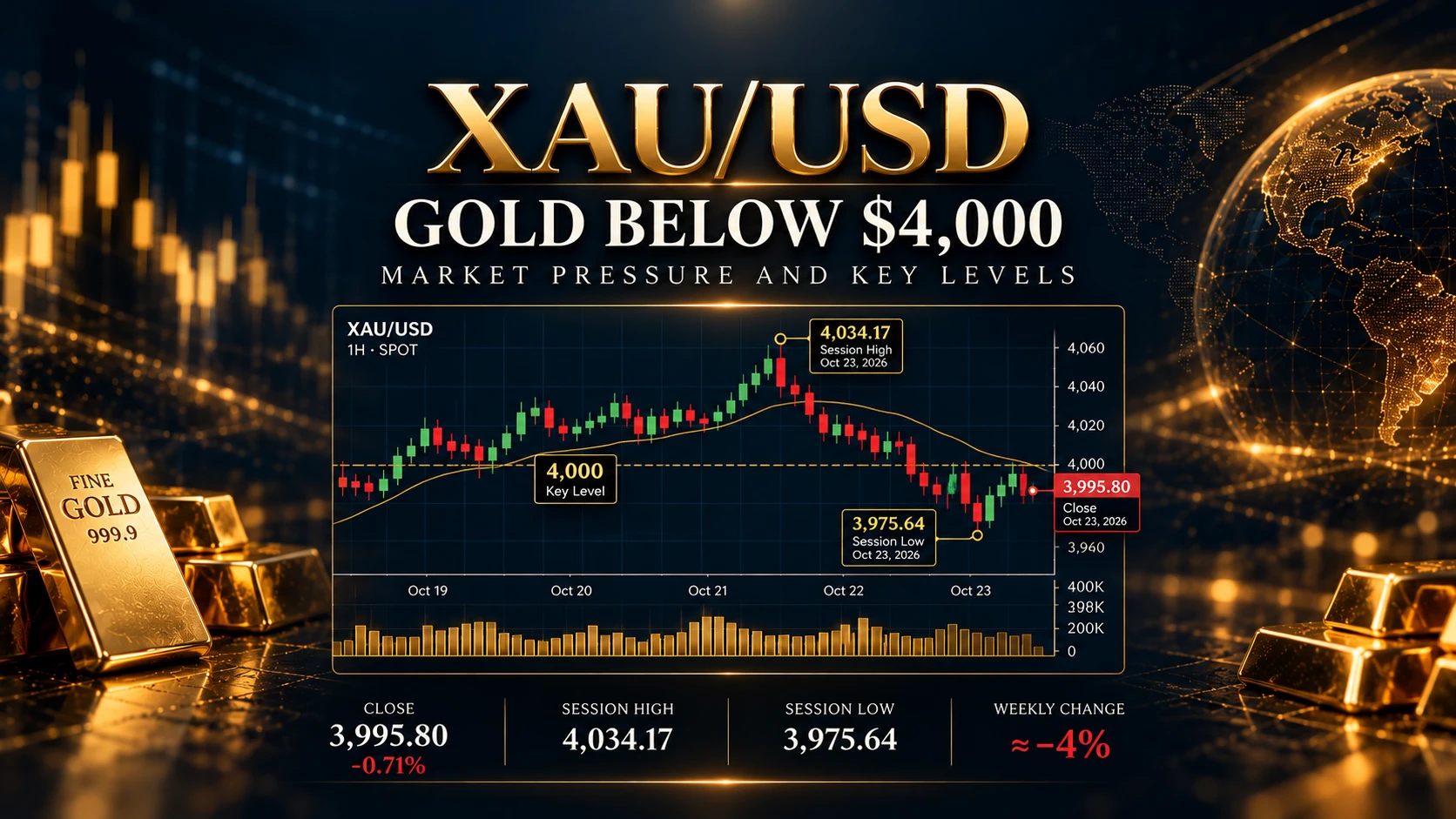
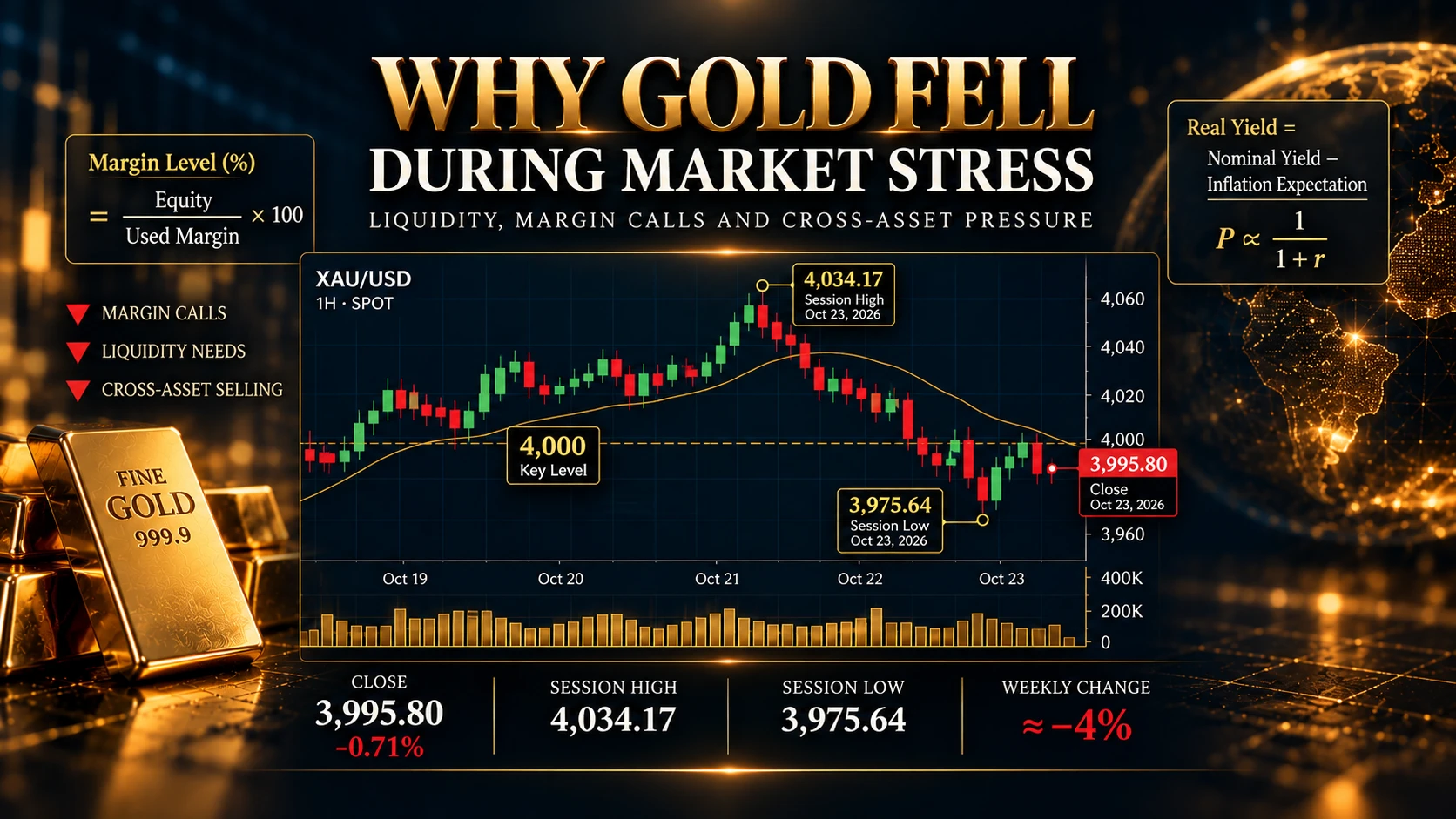
According to the historical XAU/USD price series used for this edition, gold closed the October 23 session at approximately $3,995.80 per troy ounce, below the psychologically prominent $4,000 level. The recorded session high was $4,034.17, while the low reached $3,975.64. These observations indicate that the market traded on both sides of the round-number reference before ending the session slightly below it. The significance of this structure depends on what happens next. A sustained recovery above $4,000 would represent a different development from repeated failures to reclaim the level. A further decline beneath the previous session low would indicate continued downside pressure, although it would not establish the magnitude or duration of any subsequent movement.
The approaching Federal Reserve decision adds another source of uncertainty because market participants may adjust positions before and after new information becomes available. However, increased uncertainty does not guarantee increased volatility, and an important scheduled event does not necessarily produce a large directional movement. The response must be observed rather than assumed.
Why Federal Reserve Policy Matters for Gold
Gold does not provide a contractual interest payment. For that reason, changes in the expected return on interest-bearing assets can influence the relative attractiveness of holding gold. When investors anticipate higher interest rates, the opportunity cost of holding a non-yielding asset may increase. Conversely, expectations of lower rates can reduce that opportunity cost. But this relationship is conditional. Gold is also influenced by inflation expectations, currency movements, demand for defensive assets, institutional positioning and financial liquidity. The Federal Reserve affects several of these variables through its policy decisions and communications. The market's interpretation of policy therefore involves more than the current federal funds rate. Investors also evaluate the expected future path of monetary policy. A central bank may leave its current rate unchanged while communicating information that substantially changes expectations for future meetings. Such communication can influence Treasury yields, the dollar and gold even when the immediate policy decision contains no surprise.
Nominal Interest Rates and Real Yields
One of the most important distinctions in gold analysis concerns nominal and real interest rates. A nominal interest rate represents a stated return before adjusting for inflation. A real interest rate reflects purchasing-power considerations. A commonly used approximation is: Real yield ≈ Nominal yield − Expected inflation This approximation is useful for explaining the economic relationship, although actual market-based measures may incorporate additional factors, including liquidity and risk premia. For gold, changes in real yields can influence the opportunity cost of holding a non-yielding asset. Higher real yields may create headwinds for gold, while lower real yields may be supportive, other conditions being equal. However, the relationship is not a deterministic trading rule.
Gold may rise during periods of increasing real yields if other influences are sufficiently strong. It may also decline when real yields fall because of changes in liquidity, currency conditions or investment demand. The correct analytical approach is to examine real yields alongside other market variables rather than treating them as a complete forecasting model.
Inflation Expectations and the Gold Paradox
Gold is frequently described as an inflation hedge. This description requires qualification. Inflation can influence demand for gold over certain horizons, but the immediate market response depends on monetary-policy expectations and financial conditions. A higher-than-expected inflation reading may increase interest in gold as a store of value. At the same time, it may cause investors to anticipate higher interest rates, which can increase the opportunity cost of holding gold. These influences can operate in different directions. Consequently, a surprisingly high inflation figure does not guarantee that gold will appreciate. Likewise, lower inflation does not automatically imply that gold will decline. The reaction depends on the difference between the published information and prior expectations, as well as how that difference changes anticipated policy and financial conditions. This is why market expectations are central to macroeconomic analysis. The number published in an economic report is only one part of the event.
The U.S. Dollar and XAU/USD
Gold is commonly quoted internationally in U.S. dollars. Changes in the dollar can therefore influence the effective price of gold for investors using other currencies. A stronger dollar may create headwinds for dollar-denominated gold under certain conditions. A weaker dollar may support demand. However, these relationships are not fixed. Gold and the dollar can sometimes appreciate together during periods of uncertainty. They can also decline together when other financial forces dominate. For the proposed NSI Market framework, dollar movements should be treated as contextual observations rather than universal directional instructions. The relevant question is whether changes in the dollar coincide with meaningful changes in gold-market structure and whether those relationships persist under comparable conditions.
The Difference Between a Policy Decision and a Policy Surprise
Financial markets do not wait passively for official announcements. Participants form expectations using economic releases, central-bank communications, futures markets, surveys and other information. Those expectations can already influence asset prices. When the Federal Reserve announces a decision, the market compares the new information with the anticipated outcome. A surprise can arise from the interest-rate decision itself, the accompanying statement or subsequent communication. The direction of the reaction depends on how the information changes expectations about future financial conditions. A rate increase that was fully anticipated may produce little immediate reaction. An unchanged rate accompanied by unexpectedly restrictive communication may influence yields and currencies more substantially. A seemingly supportive announcement may also produce an unfavorable gold response if investors interpret other elements of the communication differently. This illustrates why describing every market movement as a direct response to the headline decision can be misleading. The relevant information is multidimensional.
What the Federal Reserve Cannot Tell Us About Trader Psychology
A major monetary-policy announcement can create demanding conditions for traders. Prices may move quickly, spreads may change and previously established technical structures may become less reliable. However, these observations do not reveal whether traders are collectively experiencing fear, greed or impaired cognitive control. Some participants may be reducing exposure because of institutional risk limits. Others may be hedging existing positions. Some may be responding systematically to new information. Others may be acting discretionarily. The same market movement can emerge from these different activities. NSI Market should therefore distinguish observable market conditions from psychological interpretations. A volatility spike is a measurable event. Collective fear is a psychological claim requiring different evidence.
NSI Market Dashboard: The Five-Dimension Interpretation
The original Nervous System Indicator proposes five conceptual dimensions concerning the human decision-maker. These are Threat Response, Reward Activation, Cognitive Control, Social and Emotional Contagion, and Recovery Capacity. Applying the framework to market-wide observations requires an explicit methodological distinction. The market does not possess one nervous system. Consequently, the following dashboard concepts represent possible market-context proxies, not direct measurements of the five original psychological constructs.
Threat Response — Market Pressure Proxy
Relevant observations may include rapid adverse price movement, volatility expansion, liquidity deterioration and changes in financial exposure where appropriate data exist. Before the Federal Reserve announcement, researchers could examine whether gold-market conditions become more unstable as participants adjust positions. However, these observations would not establish that investors are afraid.
Reward Activation — Momentum and Price-Extension Proxy
Rapid price acceleration, sustained directional movement and unusually extended trading conditions may create environments in which anticipated reward becomes salient to individual traders. But price momentum cannot measure dopamine, greed or FOMO. A market-context score could describe the intensity of observable momentum conditions without assigning a psychological diagnosis.
Cognitive Control — Decision-Complexity Proxy
Conflicting technical signals, rapid reversals and changes in execution conditions may increase the complexity of decisions faced by certain strategies. The relevant market observation concerns the environment, not the cognitive competence of individual participants. A complex market does not prove that traders have lost control.
Social and Emotional Contagion — Narrative Convergence Proxy
Public commentary, news sentiment and available positioning information may reveal whether market narratives are becoming more concentrated or divergent. However, narrative similarity does not automatically establish emotional contagion. A rigorous study would need to distinguish shared reactions to common information from social influence among participants.
Recovery Capacity — Individual Research Dimension
Recovery Capacity cannot be estimated from XAU/USD prices, Treasury yields or Federal Reserve communications. It concerns characteristics of individual functioning that require appropriate personal measurements. For a market-only dashboard, this dimension should display: N/A — Individual Data Required Inventing a global recovery score would misrepresent the original NSI concept.
Three Conditional XAU/USD Scenarios
The approaching Federal Reserve meeting creates several possible market paths, but none should be treated as a guaranteed outcome.
Scenario One: Recovery and Sustained Acceptance Above $4,000
If XAU/USD moves above $4,000 and maintains that position through repeated observations, the previous breakdown may prove less durable than initially appeared. Researchers would examine whether the recovery is supported by changing yields, dollar conditions and broader market participation. A move above the level alone would not confirm a sustained bullish regime.
Scenario Two: Rejection Near $4,000
If gold repeatedly approaches the round-number reference and fails to maintain higher prices, the area may continue functioning as an important market boundary. The significance of such rejection would depend on the surrounding volatility and available liquidity. Repeated failure to reclaim a level is an observation about price structure, not evidence that traders are collectively afraid.
Scenario Three: Continued Weakness Below the Previous Session Low
If XAU/USD trades below the October 23 low near $3,975.64, the latest downside reference would have been exceeded. That would indicate continued selling pressure relative to the previous session. However, it would not establish that the decline must continue or that a particular lower target will be reached. New macroeconomic information could alter the market's interpretation rapidly. These scenarios should be updated after actual price observations become available.
Why the First Reaction May Not Be the Final Reaction
Major economic announcements can generate several phases of market activity. An initial movement may reflect rapid algorithmic processing of the headline information. Subsequent transactions may incorporate the broader statement, changing yield expectations and revised positioning. Later price behavior may reflect additional analysis and liquidity conditions. Therefore, the first directional movement following an announcement does not necessarily represent the market's final interpretation. However, there is no universal rule that the first movement must reverse. Some initial reactions persist, while others change direction. A scientifically credible NSI Market analysis should evaluate the observed sequence rather than impose a predetermined narrative.
Market Volatility and Decision Vulnerability
An increase in volatility can alter the practical consequences of trading. Protective orders may be executed under different liquidity conditions. Spreads can widen. Slippage may become more significant. Technical reference levels may be crossed rapidly. These changes can affect strategies differently. A method designed for ordinary intraday conditions may become less suitable during a major economic announcement. Another strategy may be explicitly designed to operate during elevated volatility. The correct interpretation depends on the financial method being used. For NSI research, the interesting question is whether changing market conditions are associated with identifiable deviations from documented strategies. That relationship cannot be established from market data alone. It requires appropriate behavioral records and independent evaluation.
What Should Be Measured After the Announcement?
A useful post-announcement research review should compare conditions before and after the event. Relevant observations may include realized volatility, price ranges, changes in the U.S. dollar, Treasury yields and the market's response to important reference levels. Researchers may also examine whether directional movement persists or reverses during subsequent observation windows. The measurements should use consistent data sources and clearly defined time periods. If volume or liquidity information is unavailable, the analysis should acknowledge that limitation rather than substitute invented values. The objective is to create a reproducible historical record. Such records could eventually support empirical testing of NSI Market hypotheses.
The Limits of Predictive Claims
An economic calendar identifies when scheduled information is expected. It does not establish how prices will react. A technical level identifies a reference point. It does not guarantee support or resistance. A market-context model may identify volatility or momentum conditions. It does not automatically predict trader emotions or future prices. The proposed NSI Market framework should therefore be evaluated according to clearly defined objectives. If the goal is to describe market conditions, the relevant criteria concern measurement accuracy and reproducibility. If the goal is to predict a future market outcome, independent predictive testing is necessary. If the goal is to investigate trader behavior, appropriate individual behavioral evidence is required. These objectives should not be confused.
Conclusion: The Federal Reserve Changes Expectations, Not Human Nature
The approaching Federal Reserve decision places gold within an environment shaped by monetary-policy expectations, inflation concerns, interest-rate dynamics and changing financial conditions. The market's response will depend not simply on the announced decision but on how the new information compares with what participants previously expected. Gold's relationship with nominal rates, real yields and the U.S. dollar is economically important, but none of these variables operates as a universal directional rule. The October 23 closing price below $4,000 provides a relevant technical reference for the next trading session. Whether the market recovers, consolidates or declines further must be established through subsequent observations. Within NSI Market, the objective is to examine these developments without confusing market behavior with collective psychological measurement.
Volatility can be measured. Momentum can be measured. Changes in price structure can be documented. But the emotional state of global market participants cannot be inferred reliably from those variables alone. I believe the scientific value of NSI Market lies in this discipline: understanding what the evidence reveals while refusing to manufacture certainty where evidence is incomplete. The Federal Reserve can change the financial conditions under which traders make decisions. It cannot tell us what every trader feels, and its announcements do not remove the uncertainty inherent in the next XAU/USD movement. That distinction is essential to the development of a credible market-intelligence framework.
Gabriel Nicolaev – CyGuru
Frequently Asked Questions
When is the October 2026 Federal Reserve meeting?
The scheduled FOMC meeting takes place on October 27–28, 2026. The official Federal Reserve calendar provides the authoritative schedule.
Why do Federal Reserve decisions influence gold?
Monetary-policy decisions and communications can influence interest-rate expectations, real yields, the U.S. dollar and broader financial conditions, all of which may affect gold.
Does a Federal Reserve rate increase always cause gold to fall?
No. Market reactions depend on expectations, the content of the announcement and other financial conditions.
Can gold rise when interest rates increase?
Yes. Gold can appreciate during periods of rising rates when other influences, such as changes in inflation expectations, investment demand or financial uncertainty, are sufficiently important.
What are real yields?
Real yields reflect returns adjusted for expected inflation. A simplified approximation subtracts expected inflation from the nominal yield.
Why is the $4,000 level important?
It is a prominent round-number reference that may attract market attention. Its actual significance depends on price behavior, liquidity and market participation.
What is a hawkish Federal Reserve surprise?
A hawkish surprise occurs when the new policy information is more restrictive than market participants previously anticipated.
What is a dovish Federal Reserve surprise?
A dovish surprise occurs when new policy information is less restrictive than expected, potentially changing anticipated interest-rate paths.
Can NSI Market measure collective fear before the Fed announcement?
No. NSI Market can investigate observable conditions such as volatility and momentum, but these do not directly measure collective emotional states.
Can NSI predict the direction of gold after the FOMC meeting?
No independently validated NSI-based capability to predict XAU/USD direction has been established.
Selected Scientific and Institutional Bibliography
-
Federal Reserve Board of Governors. (2026). Federal Open Market Committee — Meeting Calendars and Information. Official FOMC meeting schedule, including October 27–28, 2026.
https://www.federalreserve.gov/monetarypolicy/fomccalendars.htm -
Federal Reserve Board of Governors. Monetary Policy: Principles and Practice. Official explanations of monetary-policy transmission, interest rates, inflation expectations and financial conditions.
https://www.federalreserve.gov/monetarypolicy.htm -
Federal Reserve Bank of New York. Survey of Market Expectations. Primary institutional research on market participants' expectations concerning monetary policy and economic conditions.
https://www.newyorkfed.org/markets/survey_market_expectations -
Federal Reserve Bank of New York. Survey of Primary Dealers. Research on primary dealers' expectations regarding Federal Reserve policy and financial-market conditions.
https://www.newyorkfed.org/markets/primarydealer_survey_questions -
U.S. Bureau of Economic Analysis. (2026). News Release Schedule. Official release calendar for gross domestic product, personal income, personal consumption expenditures and related economic indicators.
https://www.bea.gov/news/schedule -
U.S. Bureau of Labor Statistics. (2026). Economic News Release Schedule. Official publication calendar for inflation, employment and other economic indicators relevant to monetary-policy expectations.
https://www.bls.gov/schedule/news_release/ -
Federal Reserve Bank of St. Louis. FRED Economic Data — Market Yield on U.S. Treasury Securities at 10-Year Constant Maturity (DGS10).
https://fred.stlouisfed.org/series/DGS10 -
Federal Reserve Bank of St. Louis. FRED Economic Data — Market Yield on U.S. Treasury Securities at 10-Year Constant Maturity, Inflation-Indexed (DFII10). A market-based measure of real Treasury yields.
https://fred.stlouisfed.org/series/DFII10 -
Federal Reserve Bank of St. Louis. FRED Economic Data — 10-Year Breakeven Inflation Rate (T10YIE). A market-derived inflation compensation measure that also reflects risk and liquidity premiums.
https://fred.stlouisfed.org/series/T10YIE -
World Gold Council. Goldhub Research — Gold, Interest Rates and Macroeconomic Drivers. Research and analytical material examining the relationship among gold, real yields, currencies and investment demand.
https://www.gold.org/goldhub/research -
Baur, D. G., & Lucey, B. M. (2010). Is gold a hedge or a safe haven? An analysis of stocks, bonds and gold. Financial Review, 45(2), 217–229.
https://doi.org/10.1111/j.1540-6288.2010.00244.x -
Baur, D. G., & McDermott, T. K. (2010). Is gold a safe haven? International evidence. Journal of Banking & Finance, 34(8), 1886–1898.
https://doi.org/10.1016/j.jbankfin.2009.12.008 -
Hansen, L. P., & Sargent, T. J. (2008). Robustness. Princeton University Press. A theoretical foundation for decision-making under model uncertainty and imperfect economic knowledge.
-
Bernanke, B. S., & Kuttner, K. N. (2005). What explains the stock market's reaction to Federal Reserve policy? The Journal of Finance, 60(3), 1221–1257.
https://doi.org/10.1111/j.1540-6261.2005.00760.x -
Shmueli, G. (2010). To explain or to predict? Statistical Science, 25(3), 289–310.
https://doi.org/10.1214/10-STS330
Research limitation: These sources support the institutional, economic and methodological foundations of the article. They do not establish a deterministic relationship between Federal Reserve announcements and gold prices, validate NSI Market as a forecasting instrument or prove that market participants share a particular psychological state. Calendar information should be checked against the issuing institutions before publication.
 Market
 Market
 Market