

The question behind the social signal
Imagine ten gold analysts predict a narrow weekly price range after attending the same briefing. An eleventh analyst disagrees and identifies an overlooked funding assumption. The dissenter may be wrong about price, but the disagreement can still expose the fragility of the group's reasoning. The research question is not whether contrarians outperform; it is whether independently generated dissent helps a group test an otherwise unquestioned assumption. Without knowing how forecasts were formed, a nearly unanimous distribution can look more informative than it actually is. Lorenz and colleagues conducted a controlled experiment showing how social influence can undermine some conditions that make collective estimates useful [1]. One lesson is that publicly visible opinions may converge without a corresponding improvement in the accuracy of the original independent information. In financial commentary, a cluster of forecasts is often quoted as evidence that 'the market expects' a particular outcome. If the forecasts derive from repeated exposure to the same prominent analyst, the effective number of independent observations may be far lower.
Madirolas and de Polavieja studied collective estimation and individuals' resistance to social influence [2]. Their results suggest a nuanced question: independent judgement and willingness to revise are not simple opposites. A person who ignores everyone can remain stubbornly inaccurate, while a person who follows every visible opinion can erase useful diversity. The desirable property is disciplined weighting of evidence, not dissent for its own sake. A minority view should be evaluated through its factual basis and calibration, rather than rewarded automatically because it is unusual.
What experiments and information networks show
Moussaïd and colleagues examined how social influence can shape opinion dynamics in groups [3]. These experiments help distinguish informational change from social alignment. A trader might narrow an estimate because genuinely informative evidence arrived; another might narrow it because disagreement became uncomfortable. The same numerical convergence can emerge from different mechanisms. To distinguish them experimentally, record forecasts before group contact, expose participants to controlled social information and collect revised estimates with stated reasons afterward. For a gold-specific study, a useful task could ask participants to estimate the uncertainty around an upcoming macroeconomic release's possible effects, without implying that any one price outcome is known. Randomize access to independent evidence and displayed forecasts, including a structured dissent memo. The memo should disclose concrete reasons and uncertainties rather than emotional rhetoric. An adequate control condition would show the same base facts without the dissent framing. Comparing only the loudest groups with quiet ones would confound social pressure with expertise and information availability.
The quality metrics should be specified in advance. Evaluate prediction errors over appropriate horizons, interval coverage, calibration where probabilities are elicited, and whether participants identify contradictory evidence. A simple count of how many people changed their answer could misclassify thoughtful correction as weakness. Likewise, a group that grows confident is not necessarily becoming more accurate. A useful research note would publish the full distribution of individual changes, not merely the majority vote or a memorable winner. Market narratives create another difficulty because different participants can use different definitions of 'bullish.' One may expect a higher closing price, another a stronger risk-adjusted return, and another a temporary price spike around data. These should not be aggregated until they have been translated into a common, timestamped question. Without compatible horizons and outcome variables, even independent forecasts do not form a coherent crowd estimate. Carefully defining the proposition is therefore as important as recruiting a diverse set of views.
Operational tests, boundaries and conclusion
A terminal feature could preserve an 'independent first estimate' before displaying consensus, then show a separate reconciliation stage. The objective would not be to engineer disagreement but to retain a record of what the person thought before social signals appeared. Researchers could then investigate whether a dissent memo improved detection of neglected assumptions. This is a proposed behavioral design, not an established method to extract profitable prices from disagreement. Any evaluation must separate prediction quality from traders' subjective satisfaction with the discussion. When a Thousand Forecasts Are Really One discusses dependence among estimates. When Discussion Makes a Group More Certain examines polarization and deliberation. When the Crowd Agrees studies the broader loss of independence after social exposure. These articles provide complementary foundations for a controlled dissent experiment, but none implies that an isolated minority is naturally superior or possesses privileged market information.
The conclusion is that dissent has potential value as an error-detection mechanism, not as a countertrend indicator. NSI could test whether a structured minority argument makes collective reasoning more transparent and calibrated. The hypothesis concerns human judgement under social influence; it does not validate any neurological prediction of gold, and every result should preserve evidence quality, task design and uncertainty.
Scientific bibliography & sources
- Lorenz J et al. How social influence can undermine the wisdom of crowd effect. PNAS (2011). https://pmc.ncbi.nlm.nih.gov/articles/PMC3107299/
- Madirolas G, de Polavieja GG. Improving collective estimations using resistance to social influence. PLOS Computational Biology (2015). https://journals.plos.org/ploscompbiol/article?id=10.1371/journal.pcbi.1004594
- Moussaïd M et al. Social influence and the collective dynamics of opinion formation. PLOS ONE (2013). https://journals.plos.org/plosone/article?id=10.1371/journal.pone.0078433
Research note
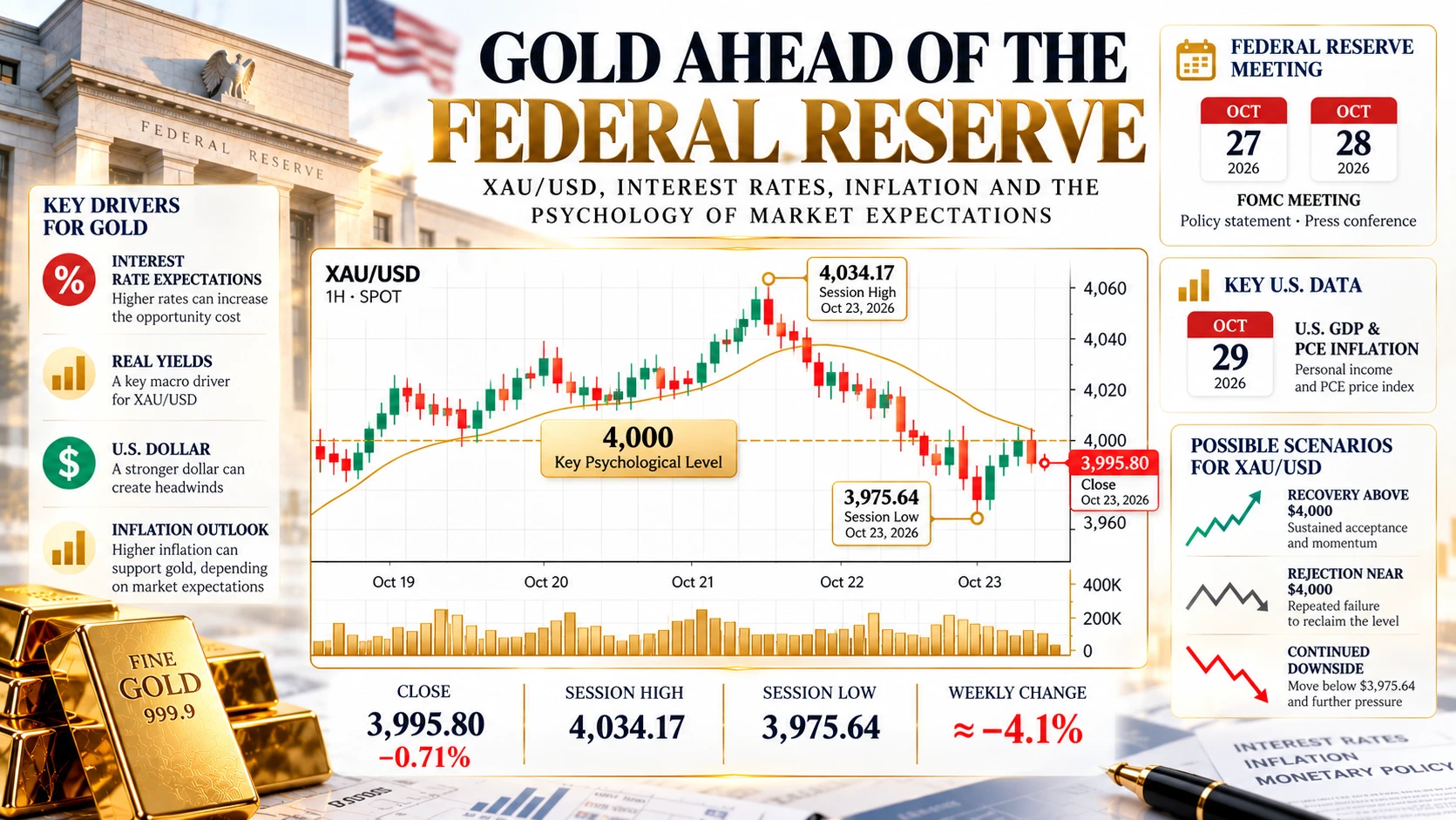
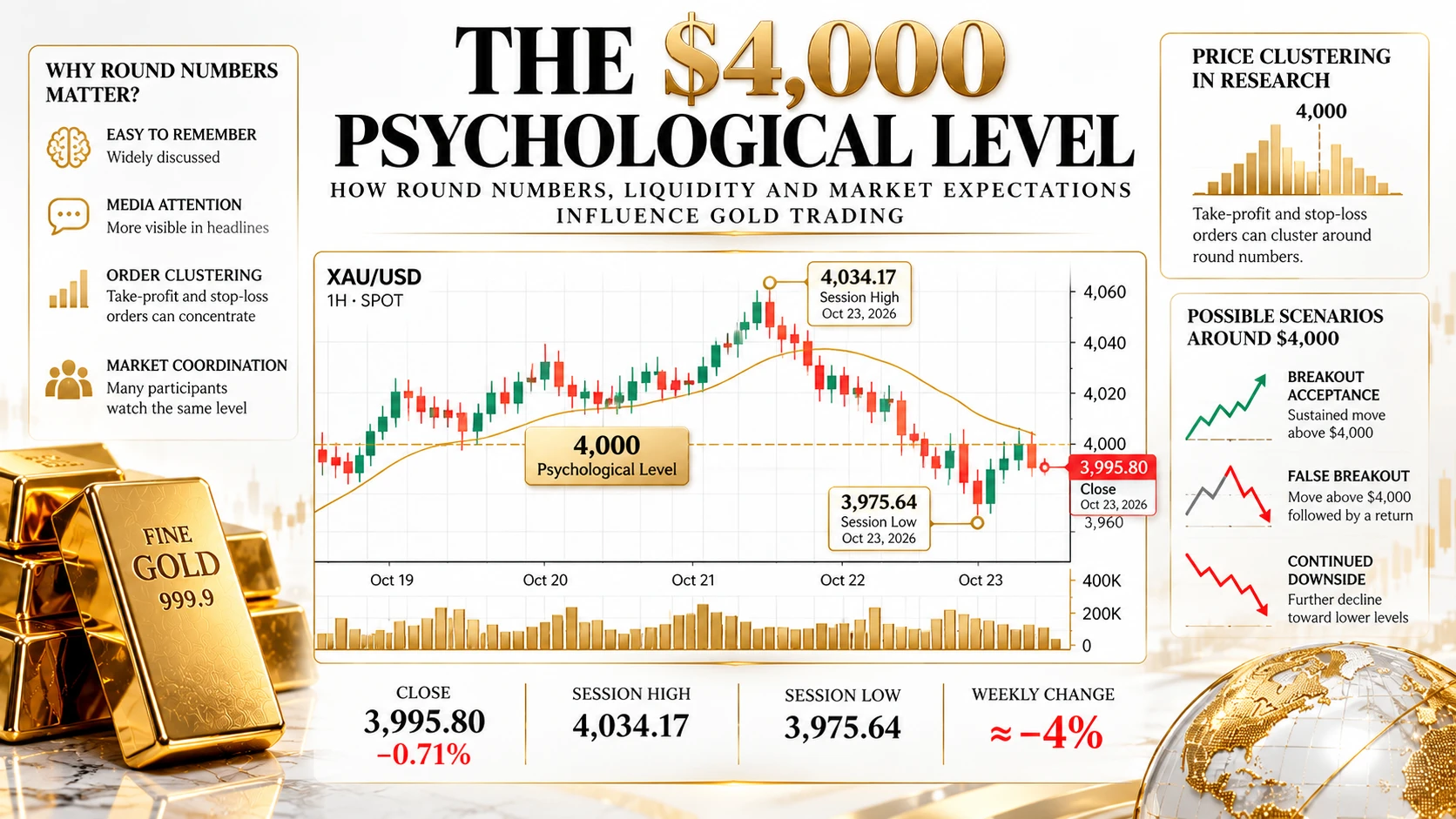
NSI is a proposed research framework, not an independently validated medical or financial prediction system. This article is research and education, not individualized medical or investment advice. Market observations are timestamped historical context, not live prices.
 Market
 Market
 Research