
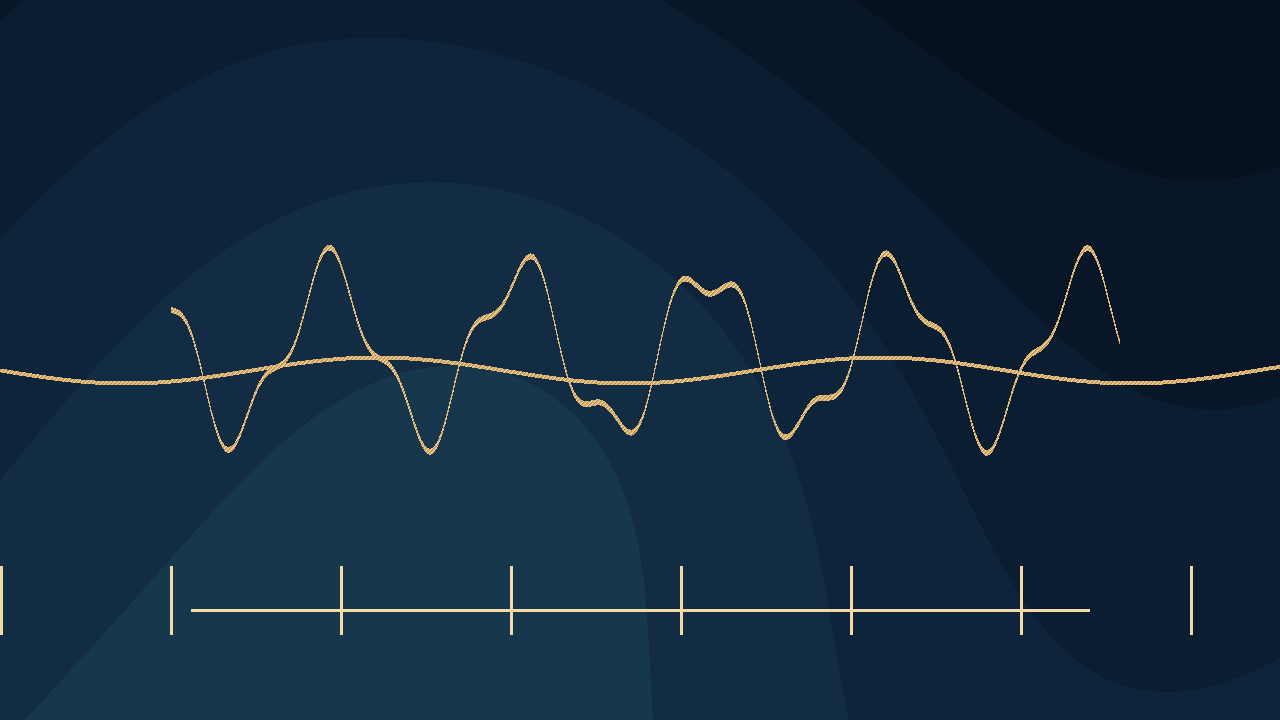
Two clocks can run inside one market experiment
An analyst records an EEG-related feature during a long session of reading gold-market charts and alerts. At the beginning, the readings appear stable. Later, a major headline arrives and the feature changes. The easy explanation is that the new information altered the nervous system. But another clock has been running since the session began: the participant has been concentrating, switching screens, suppressing distractions and possibly accumulating fatigue. The research question is whether a measured change belongs to the headline or to the gradual passage of time under cognitive load. Boksem, Meijman and Lorist studied mental fatigue during extended attention-task performance and reported changes in subjective fatigue, behavioral efficiency and EEG-related measures [1]. Their findings demonstrate that physiology and attention can evolve during task performance even without a surprising financial event. That matters because a gold-news study often includes many hours of observation, especially when researchers search retrospectively for moments of high volatility. If later headline events receive systematically different fatigue exposure than earlier ones, event type and time-on-task become entangled.
Van Dongen and colleagues used controlled sleep-restriction experiments to examine how cognitive performance changes under different amounts of sleep opportunity [2]. This research does not describe individual gold traders or prove that a given trading mistake was caused by sleep loss. It establishes an important background fact: waking performance can change substantially as sleep and wakefulness conditions change. In a market experiment, participants' recent sleep and duration of wakefulness can be plausible confounders, not just lifestyle details. The archive's discussion of sleep timing variability is therefore directly relevant to experimental design.
How to distinguish the headline effect from the session effect
Researchers should counterbalance when different stimuli appear. The same class of headline should not always arrive after a long period at the screen, while neutral alerts always appear at the beginning. Randomized or carefully matched event order helps separate the effect of elapsed work from the meaning of the stimulus. Baseline measurements must be defined relative to each event while also tracking broader drift across the session. Subtracting an immediately preceding baseline may not be sufficient when baseline physiology is unstable or when the participant anticipates an alert. Task switching adds another difficulty. Rubinstein, Meyer and Evans experimentally examined executive control during switches between tasks [3]. A person moving from a chart to a news feed and then to an execution panel may show changes in attention and reaction time because of the switch itself. The relevant comparison is not simply headline versus silence; it may be financial headline versus an equally demanding control task that requires a similar visual and cognitive transition. Otherwise the experiment can wrongly attribute the cost of switching screens to a specific monetary interpretation.
An event analysis should record at least the time since session start, sleep opportunity, time of day, recent task changes, whether the alert was expected, and objective performance in a control task. Event time and device time must be synchronized. The headline's financial importance should be independently classified before physiology is inspected. If the study labels an event high-impact only after seeing a large physiological response, it risks circular selection. A gold-news researcher must also identify the exact asset, timestamp and public news source rather than treating a dramatic price move as evidence that an important headline must have occurred.
What a transparent statistical comparison might show
An auditable model could compare three specifications: an event-only analysis, a time-on-task model, and a model containing both variables plus preregistered controls. The purpose is to test whether the event association survives adjustment and remains stable across participants. Results should display effect estimates and uncertainty, not just an impressive color on a heatmap. A different question concerns interaction: perhaps certain stimuli have different effects when participants are fatigued. That possibility must be tested as an explicit hypothesis, not assumed whenever a late-session response appears larger. Where market events cannot be randomized, researchers should be especially careful about causal language. Central-bank announcements have their own schedules, liquidity regimes and attention patterns. A strong effect after an announcement might reflect novelty, existing anticipation, screen switching or market volatility rather than the semantic content of the news. That concern overlaps with how should a gold news event study be designed before looking at prices, because both market and physiological event studies require rules set before outcomes are observed.
The conclusion is that elapsed effort is an active experimental variable, not empty time. Original studies [1][2][3] establish that fatigue, sleep conditions and switching can influence performance and physiological or behavioral measurements. They do not imply a validated mapping from those measurements to future XAU/USD prices. NSI is a proposed interdisciplinary research framework; it should treat a news-linked nervous-system response as a hypothesis requiring controls, not a demonstrated fear diagnosis or trading signal. A credible study is one where an alternative clock has been measured before the headline is credited with the change.
Scientific bibliography & sources
- [1] Boksem MAS, Meijman TF, Lorist MM. Effects of mental fatigue on attention: An ERP study. Cognitive Brain Research (2005). https://pubmed.ncbi.nlm.nih.gov/15913965/
- [2] Van Dongen HPA et al. The cumulative cost of additional wakefulness: dose-response effects from chronic sleep restriction. Sleep (2003). https://pubmed.ncbi.nlm.nih.gov/12683469/
- [3] Rubinstein JS, Meyer DE, Evans JE. Executive control of cognitive processes in task switching. J Exp Psychol HPP (2001). https://doi.org/10.1037/0096-1523.27.4.763
Research note
NSI is a proposed research framework, not an independently validated medical or financial prediction system. This article is research and education, not individualized medical or investment advice. Market observations are timestamped historical context, not live prices.
 Research
 Research
 Research