
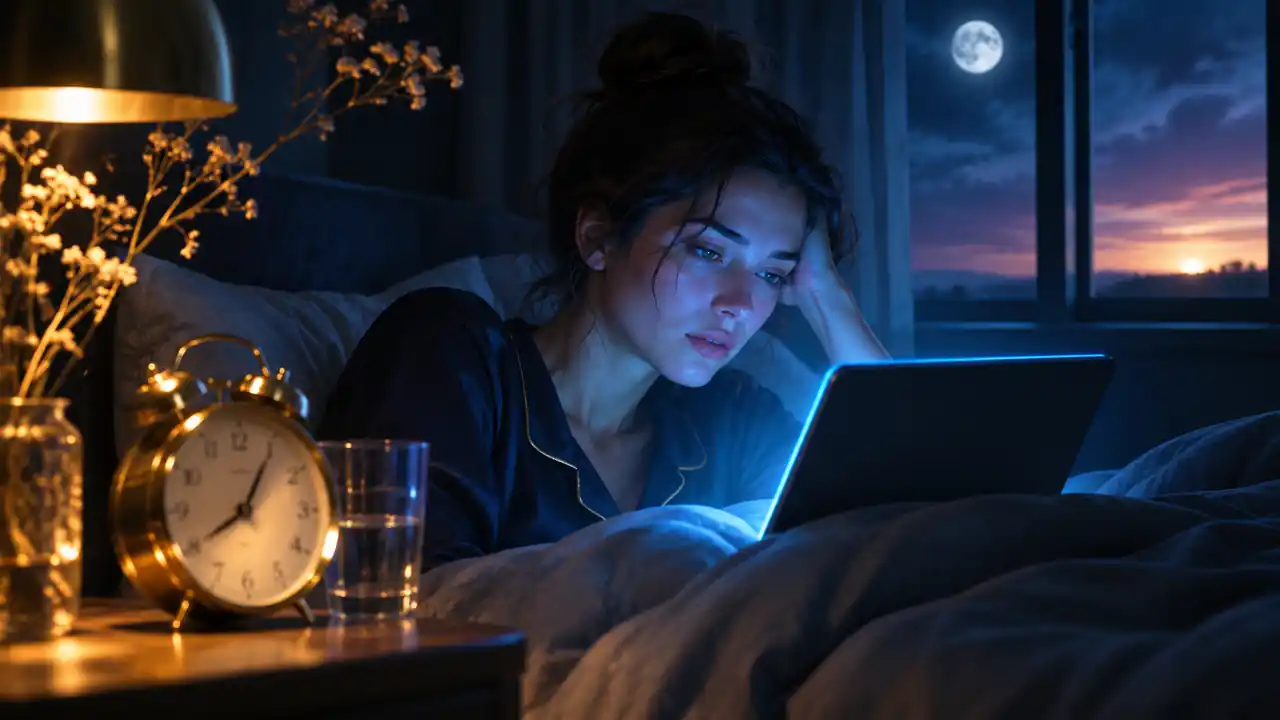
The paradox: more alert before bed, less alert tomorrow
A bright screen may make someone feel less sleepy in the evening while affecting the biological timing of sleep. This is not a contradiction: momentary alertness and circadian phase are different outcomes. The relevant question is what controlled laboratory exposure reveals about sleep onset, melatonin timing and performance the next morning. A person's impression of productivity late at night is not a direct measurement of the quality of their subsequent recovery. Any discussion of decision readiness should distinguish subjective feeling from observed attention and sleep physiology. Chang and colleagues compared reading a light-emitting electronic book with reading a printed book under controlled conditions. Evening use of the light-emitting device was associated with later circadian timing, reduced melatonin secretion, more difficulty falling asleep and lower next-morning alertness [1]. The design is especially informative because reading itself occurred in both conditions. It is nevertheless not a universal test of every modern screen, brightness setting, exposure duration or age group. Nor did the experiment test trading performance or long-term financial outcomes.
This helps refine [Sleep Timing Variability](/publications/nsi-2026-11-02-personal-01), which examines why time in bed alone cannot describe circadian alignment. Two people can report the same sleep duration and differ in the timing of their internal clocks. A study that records hours slept without considering when light exposure occurred may therefore miss an important part of the mechanism.
Light characteristics and laboratory controls
Cajochen and colleagues compared evening exposure to LED-backlit and non-LED-backlit screens in a controlled crossover study. They measured physiological markers and performance-related outcomes, including melatonin and indices of sleepiness [2]. Their result illustrates why display technology and spectral composition matter. It does not mean the word 'LED' by itself identifies an individual dose or health outcome. Light at the eyes depends on display settings, surrounding lighting, duration, distance and sensitivity, none of which can be inferred solely from a device label. Gooley and colleagues compared melatonin profiles under room-light and dim-light conditions before habitual bedtime [3]. The findings challenged an intuitive assumption that only obviously intense light matters to the circadian system. In the studied conditions, ordinary room light affected melatonin timing. Yet extrapolation must respect participant characteristics and the controlled exposure protocol. A home environment may involve a mixture of lamps, devices, changing distances and irregular schedules; it is not identical to a laboratory room with defined illumination.
The studies measure related but different features: direct melatonin exposure, device light, subjective sleepiness and downstream sleep outcomes. Combining them into a single binary 'screen damage' claim would remove important distinctions. In particular, a person might remain awake because of emotional content, late work, caffeine or schedule pressure in addition to any light effect. Without separating these factors, a change in next-day attention cannot be attributed confidently to one cause.
Applying the evidence without inventing a trading rule
Imagine an analyst reviewing prices and messages before bedtime. The screen may deliver both biologically relevant light and psychologically engaging information. If the analyst feels alert at midnight, that momentary sensation does not establish that tomorrow's decision quality will be intact. A reasonable research design would record the exposure schedule and quantify sleep, circadian measures and next-day performance using predefined outcomes. Simply asking the analyst whether they felt ready would be weaker evidence. The related study of [The Hidden Cost of Six Hours of Sleep](/publications/nsi-2026-10-30-personal-01) addresses repeated sleep restriction rather than light exposure. These variables should not be merged. Someone may have adequate sleep opportunity but shifted circadian phase, or insufficient sleep opportunity despite low evening light. Their interventions and predicted physiological responses are not automatically interchangeable. Similarly, [Caffeine Can Restore Alertness Without Erasing Sleep Debt](/publications/nsi-2026-10-30-personal-04) describes a separate path by which apparent alertness can diverge from underlying recovery.
A proposed NSI study could test whether objectively documented evening exposure predicts next-morning vigilance after accounting for prior sleep, chronotype and work schedules. It would need prospective measurements and uncertainty estimates, not a hand-picked example. Even if an association with vigilance were found, demonstrating better investment decisions would require another study with defined decisions, error metrics and real execution costs. No biological observation alone identifies the direction of an asset price.
Conclusion: distinguish evening wakefulness from recovery
Primary experiments support the idea that evening light can affect melatonin and circadian timing [1–3], and some controlled exposures were linked to reduced next-morning alertness [1]. The findings justify asking more precise questions about screens, lighting and sleep schedules. They do not establish a personalized diagnosis or a profitable trading schedule. NSI is a proposed interdisciplinary research framework; it is not a clinically validated sleep diagnostic system or a financially validated prediction mechanism.
Scientific bibliography & sources
- [1] Chang AM et al. Evening use of light-emitting eReaders negatively affects sleep, circadian timing, and next-morning alertness. PNAS (2015). https://pmc.ncbi.nlm.nih.gov/articles/PMC4313820/
- [2] Cajochen C et al. Evening exposure to an LED-backlit computer screen affects circadian physiology and cognitive performance. Journal of Applied Physiology (2011). https://pubmed.ncbi.nlm.nih.gov/21415172/
- [3] Gooley JJ et al. Exposure to room light before bedtime suppresses melatonin onset and shortens melatonin duration in humans. J Clin Endocrinol Metab (2011). https://pubmed.ncbi.nlm.nih.gov/21193540/
Research note
NSI is a proposed research framework, not an independently validated medical or financial prediction system. This article is research and education, not individualized medical or investment advice. Market observations are timestamped historical context, not live prices.
 Market
 Market
 Research